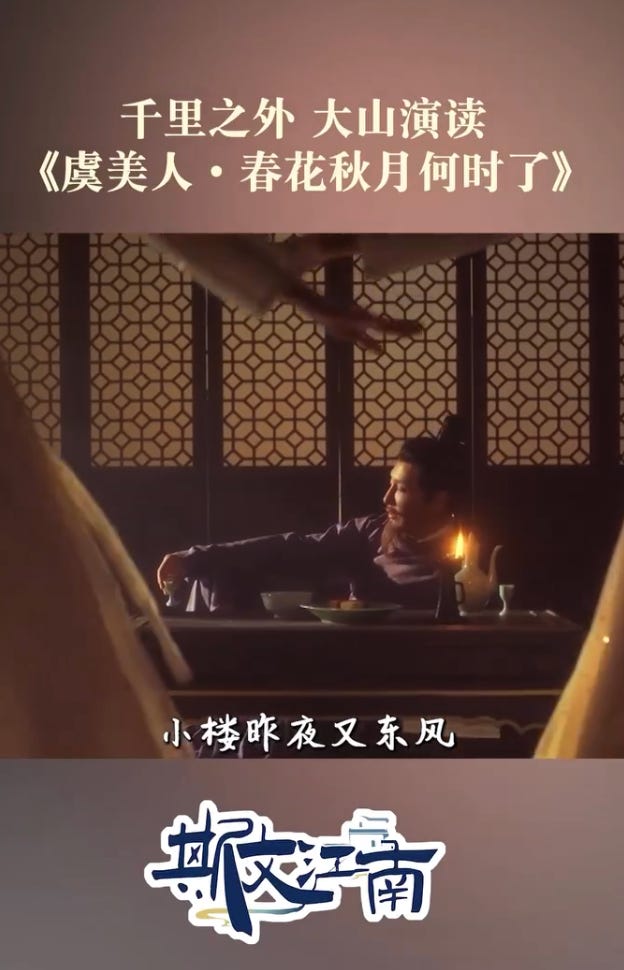
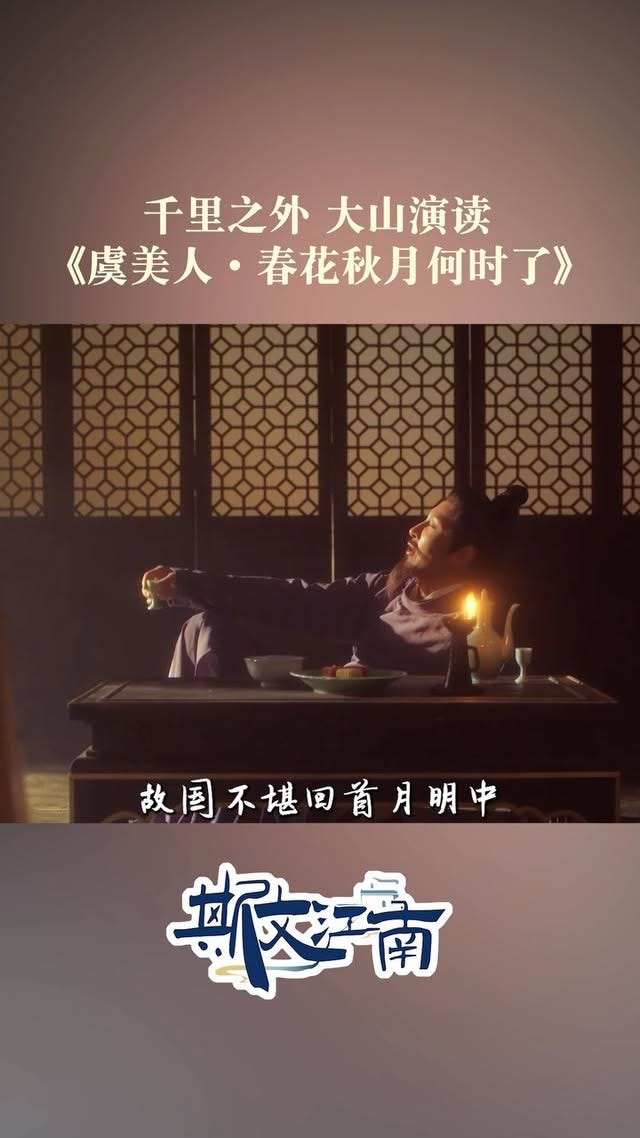
《虞美人·春花秋月何时了》
南唐 · 李煜

春花秋月何时了,
往事知多少?
小楼昨夜又东风,
故国不堪回首月明中!
雕阑玉砌应犹在,
只是朱颜改。
问君能有几多愁?
恰似一江春水向东流!
春花秋月何时了,
Chūn huā qiū yuè hé shí liǎo,
When will the spring flowers and autumn moon ever come to an end?
往事知多少。
Wǎng shì zhī duō shǎo.
How many memories of the past still linger?
小楼昨夜又东风,
Xiǎo lóu zuó yè yòu dōng fēng,
Last night, in my little tower, the east wind blew again.
故国不堪回首月明中。
Gù guó bù kān huí shǒu yuè míng zhōng.
In the bright moonlight, I cannot bear to look back toward my lost kingdom.
雕栏玉砌应犹在,
Diāo lán yù qì yīng yóu zài,
The carved balustrades and marble steps must still remain there…
只是朱颜改。
Zhǐ shì zhū yán gǎi.
But the youthful faces have all changed.
问君能有几多愁?
Wèn jūn néng yǒu jǐ duō chóu,
Do you ask how much sorrow I can hold?
恰似一江春水向东流。
Qià sì yī jiāng chūn shuǐ xiàng dōng liú.
It is just like a whole river of spring waters, flowing endlessly east.
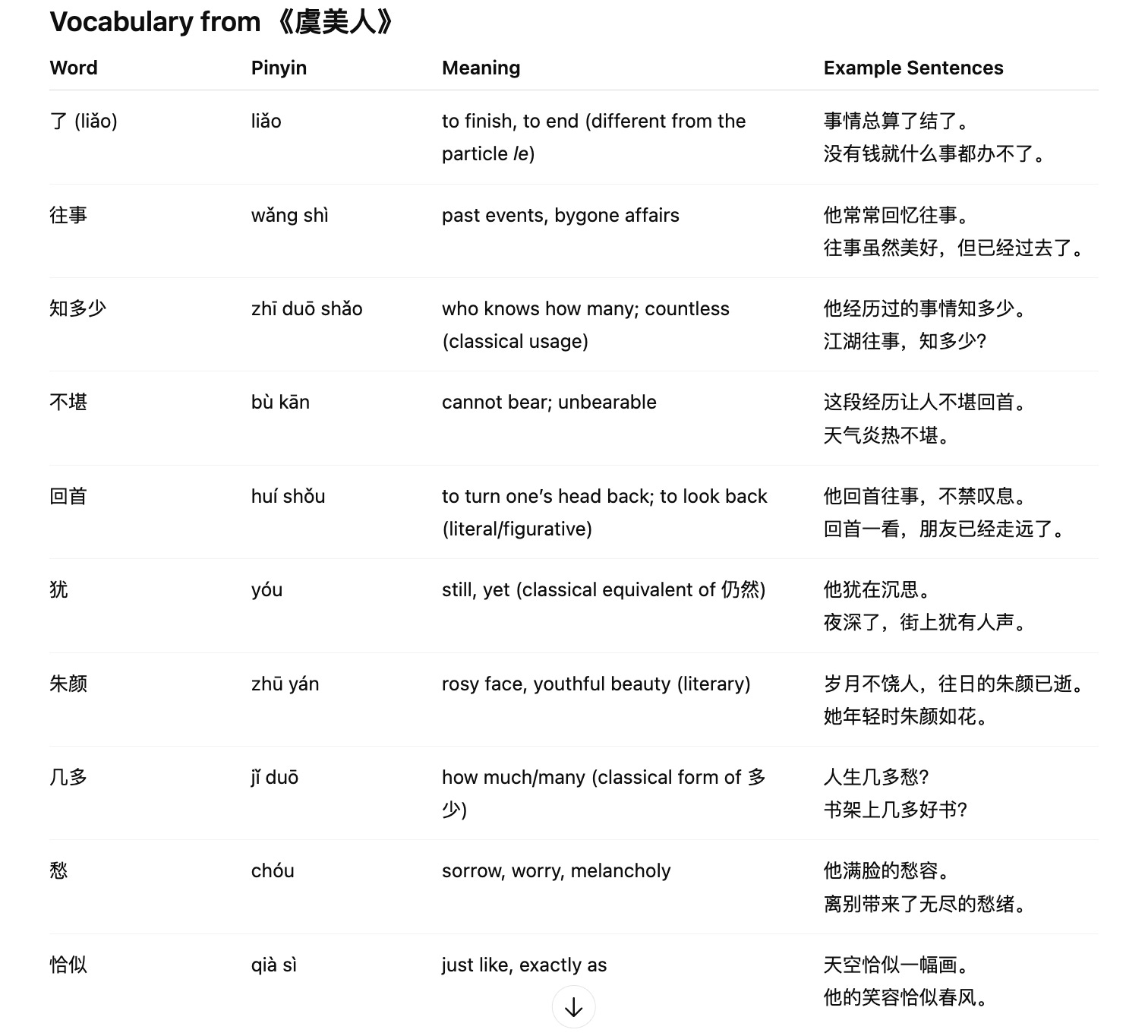
1. 春花秋月何时了
Chūn huā qiū yuè hé shí liǎo
When will the spring flowers and autumn moon ever come to an end?
春花秋月 → a parallel phrase (春–秋, 花–月) symbolizing time/seasons. These parallel couplings are common in classical poetry.
何时 = “when?” (classical equivalent of 什么时候).
了 (liǎo) here = “to end, to finish” (not the particle le).
Example: 事情了结 (shì qíng liǎo jié, “the matter is settled”).
👉 Learner’s note: watch out for liǎo vs le — same character, different use.
2. 往事知多少
Wǎng shì zhī duō shǎo
How many memories of the past still linger?
往事 = past events, bygone matters.
知多少 = literally “know how many.” In poetry it means “who knows how many” or “countless.”
This is an example of rhetorical questioning — not about an exact number.
👉 Learner’s note: 多少 is often numeric in modern Chinese, but here it’s figurative: “uncountable.”
3. 小楼昨夜又东风
Xiǎo lóu zuó yè yòu dōng fēng
Last night, in my little tower, the east wind blew again.
小楼 = “little tower” — common image for an upper chamber or residence.
昨夜 = “last night” (same as 昨天晚上).
又 = “again.” Important: in poetry it often signals recurrence, sometimes with emotional weight (“once again, I feel it…”).
东风 = the spring wind from the east, symbol of renewal, but here also a reminder of transience.
4. 故国不堪回首月明中
Gù guó bù kān huí shǒu yuè míng zhōng
In the bright moonlight, I cannot bear to look back toward my lost kingdom.
故国 = “old country,” meaning homeland (here: the fallen Southern Tang).
不堪 = “cannot endure / cannot bear.”
Example: 不堪回首 (bù kān huí shǒu) = too painful to look back.
回首 = literally “turn one’s head back,” often metaphorical: to recall the past.
月明中 = “within the bright moonlight.” Classical word order puts the modifier (月明) before 中.
👉 Learner’s note: 不堪 + verb is a strong idiom → “unbearable to do (verb).”
5. 雕栏玉砌应犹在
Diāo lán yù qì yīng yóu zài
The carved balustrades and marble steps must still remain there…
雕栏 = carved railing.
玉砌 = jade-like steps (砌 = stone steps, 玉 is figurative for white marble).
应犹在 = “must still be there.”
应 = probably / should, 犹 = still, 在 = exist.
👉 Learner’s note: 应 in classical often means “should / must,” not just “should (ought to).”
6. 只是朱颜改
Zhǐ shì zhū yán gǎi
But the youthful faces have all changed.
只是 = “only, merely.”
朱颜 = “rosy face” → youthful beauty. (朱 = red, 颜 = face).
改 = “changed.”
👉 Learner’s note: this is a compact sentence with no subject: “only (that) the faces have changed.” Classical Chinese often omits subjects when obvious from context.
7. 问君能有几多愁?
Wèn jūn néng yǒu jǐ duō chóu?
Do you ask how much sorrow I can hold?
问君 = “I ask you, sir.” 君 = polite address (like “my friend” or “sir”).
能有几多愁 = “how much sorrow could one have?”
几多 (jǐ duō) = classical variant of 多少.
👉 Learner’s note: This is a rhetorical question — the implied answer is “boundless sorrow.”
8. 恰似一江春水向东流
Qià sì yī jiāng chūn shuǐ xiàng dōng liú
It is just like a whole river of spring waters, flowing endlessly east.
恰似 = “just like.”
一江春水 = “a whole river of spring water.” 江 is large river (Yangtze, etc.).
向东流 = “flows eastward.”
Rivers in China generally flow east to the sea, so “east” symbolizes inevitability.
👉 Learner’s note: 一江春水向东流 is now an idiom meaning endless grief or longing.
Form & Structure
词牌名: 《虞美人》 is the tune name — not the content title.
对仗 (parallelism): “春花秋月” / “雕栏玉砌” — balanced pairs.
上下阕 (two stanzas):
上阕 (first half): time and memory (春花秋月 → 往事).
下阕 (second half): reality and sorrow (雕栏玉砌 → 一江春水).
Imagery: uses nature (flowers, moon, river) to reflect human feeling (愁).
The Historical Context of Li Yu’s Yu Meiren: “Spring Flowers, Autumn Moon — When Will They End?”
1. A King Between Dynasties
Li Yu (李煜, 937–978) was the last ruler of the Southern Tang, one of the Ten Kingdoms that flourished after the Tang dynasty collapsed in 907. He came to the throne in 961. By then, the Southern Tang was already weakened, hemmed in by stronger states and under the looming shadow of the newly founded Song dynasty.
2. Politics and Constraint
Traditional histories written under the Song portrayed Li Yu as a weak and indulgent monarch, more devoted to poetry and painting than to statecraft. They blamed his lack of military preparation and reliance on diplomacy for the Southern Tang’s fall.
Modern historians, however, point to a more complex picture:
The structural weakness of his state — geographically exposed, financially strained, militarily outmatched — made resistance to the Song nearly impossible.
Li Yu did act decisively at times, ordering executions and even poisonings when he perceived threats. He was not simply passive.
His investment in culture — literature, calligraphy, art — may have been a form of statecraft, projecting legitimacy and soft power at a moment when hard power was failing.
Thus, the image of Li Yu as an “unskilled politician” reflects partly the victors’ narrative of the Song, which emphasized his failures to highlight their own strength.
3. The Fall of a Kingdom
In 974 the Song launched their invasion. After a year-long siege of Nanjing, the Southern Tang surrendered. Li Yu and his family were taken north to the Song capital, Kaifeng. There he lived as a captive prince — stripped of power but not of memory.
4. The Poem in Captivity
It was in Kaifeng, as a prisoner of the Song, that Li Yu composed 《虞美人·春花秋月何时了》.
“Yu Meiren” (虞美人) is the tune name, a metrical pattern.
“Spring flowers, autumn moon — when will they end?” is the title, taken from the poem’s opening line.
The poem contrasts the endless cycles of nature with the irretrievable loss of his country and youth. The final couplet — “Do you ask how much sorrow I have? / As much as a whole river of spring waters flowing east” — became one of the most famous images of grief in Chinese literature.
Later accounts say the Song emperor Taizong, alarmed by the subversive nostalgia in Li Yu’s poems, ordered him poisoned in 978. Whether fact or legend, this story cemented the poem as his swan song.
5. Literary Transformation
Li Yu’s lyrics are remembered as the archetypal “songs of a fallen kingdom” (亡国之音). Before him, ci poetry had been light entertainment, associated with music and courtesans. With him, it became a vehicle for profound personal and historical emotion.
As Wang Guowei observed centuries later: “With Li Houzhu (Li Yu), the vision of ci broadened and its feelings deepened, turning from the songs of entertainers into the lyrics of scholars.” His work thus laid the foundation for the great Song ci tradition of Su Shi, Li Qingzhao, and Xin Qiji.
6. Legacy and Resonance
In the larger sweep of Chinese history, Li Yu’s life marks the transition from fragmentation (the Five Dynasties and Ten Kingdoms) to reunification under the Song. He became a symbol of the costs of political weakness, but also of the endurance of culture beyond politics.
In later dynastic crises, Ming loyalists and Qing-era intellectuals invoked his verse to express their own loss. In modern China, his lines — especially “a river of spring waters flowing east” — appear in novels, films, and popular songs as shorthand for boundless sorrow and nostalgia.
Cross-culturally, Li Yu has no fixed equivalent, but his image as a poet-king destroyed by history resonates with figures like Mary Stuart, remembered as both ruler and writer, or Shakespeare’s Richard II, a monarch more immortal as tragic voice than as political actor.